
What to Do When Furniture Won’t Fit Through Doors or Staircases
If your furniture won’t fit through the door, stairwell, or elevator, you’re not alone.
In Boston, furniture hoisting is sometimes the only safe and practical solution.
Safe Responsible Movers
provides professional furniture hoisting services for situations where traditional moving
routes simply don’t work.
This is not unusual, and it does not mean your move is impossible. It means the move
requires planning, experience, and the right approach.
Why Hoisting Is Sometimes Necessary
Boston’s housing stock presents challenges that don’t exist in many other cities.
Older buildings were not designed for modern furniture sizes, and even newer buildings
often have tight access points.
Furniture hoisting is commonly required because of:
- Narrow staircases and tight landings
- Long hallways with sharp turns
- Doorways that cannot accommodate oversized items
- Large sectionals or solid wood furniture
- Newer buildings with small or restrictive elevators
When standard access routes fail, hoisting becomes the safest way to complete the move
without damage or injury.
When Furniture Hoisting Is Required
Couch Won’t Fit Through the Door or Staircase
This is the most common hoisting scenario. Couches and sectionals often fit on paper but
fail in practice due to tight turns, low ceilings, or narrow stairwells.
If your couch cannot be safely maneuvered through the door or staircase, hoisting may be
the only viable option to move it into or out of the space.
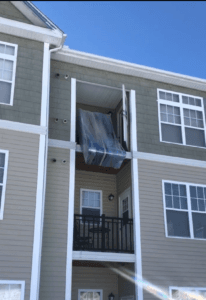
Moving Furniture Through a Window or Balcony
In some situations, furniture must be moved through a window or balcony opening because
interior access is impossible. This is common in apartments, condos, and older multi-unit
buildings.
Windows, balconies, and exterior access points are used only when appropriate and only
after careful planning. These methods require professional handling and should never be
attempted without proper experience.
Oversized or Heavy Furniture
Certain items are simply too large or heavy for interior routes, including:
- Sectional sofas
- Armoires and wardrobes
- Large dressers and solid wood furniture
- Appliances
- Treadmills and exercise equipment
Hoisting allows these items to be moved safely without forcing them through spaces they
were never meant to pass through.
How Professional Furniture Hoisting Works
Planning and Assessment
Every hoisting job begins with an assessment. We measure furniture, evaluate access points,
review building conditions, and determine whether hoisting is appropriate for the situation.
This step ensures the safest possible approach before any lifting begins.
Safe Rigging and Controlled Lifting
Professional hoisting is a controlled process. Our crews coordinate movements carefully,
using proper lifting methods and clear communication at every step.
There is no improvisation. Every movement is planned, deliberate, and executed with safety
as the priority.
Protecting Furniture and Property
Furniture and property protection are critical during hoisting. Items are properly padded,
windows and openings are protected, and interior spaces are safeguarded throughout the
process.
This level of care reduces the risk of damage and ensures the move is completed cleanly and
professionally.
Why Furniture Hoisting Is Not a DIY Job
Injury Risk
Attempting to hoist furniture without professional experience can result in serious injuries,
including back injuries, falls, and loss of control during lifting.
The risk increases significantly when working at height or through exterior openings.
Property Damage Risk
DIY hoisting attempts frequently result in broken windows, damaged exteriors, or dropped
furniture. These mistakes are costly and often far exceed the cost of professional service.
Professional hoisting minimizes these risks through planning, coordination, and experience.
Boston-Specific Hoisting Experience
Triple-Deckers and Older Buildings
Boston’s triple-deckers and older apartment buildings are among the most common locations
where hoisting is required. Tight staircases and limited access make standard moves difficult.
Our crews understand how these buildings are constructed and how to work within their
constraints safely.
Tight Urban Streets and Access Constraints
Urban access adds another layer of complexity. Narrow streets, limited parking, and building
restrictions all affect how hoisting is planned and executed.
Experience in Boston matters when working in these conditions.
Furniture Hoisting vs Other Moving Services
Hoisting vs Single-Item Movers
Single-item movers focus on scope: one item, one pickup, one delivery. Furniture hoisting
focuses on access.
Hoisting may involve one item or several, but the defining factor is that standard access
routes do not work.
Hoisting vs Labor-Only Movers
Labor-only moving provides manpower without specialized planning. Furniture hoisting
requires coordination, assessment, and controlled execution.
This is not just heavy lifting. It is a specialized service.
Get a Quote for Furniture Hoisting in Boston
If your furniture will not fit through the door, stairwell, or elevator, professional hoisting
may be the right solution.
Request a quote
to discuss your situation with experienced movers who understand Boston buildings and
know how to handle complex access challenges s