
Seaport and Fort Point Movers for High-Rises, Lofts and Offices
Moving in Boston’s Seaport or Fort Point requires more planning than simply reserving a truck and choosing a date. A Seaport high-rise may require a certificate of insurance, a reserved freight elevator, a loading-dock appointment and approval from the concierge or property manager. A Fort Point loft may have an elevator, but it may also have unusual door dimensions, a long route from the curb or oversized furniture that was assembled inside an open industrial space.
Safe Responsible Movers has handled moves throughout Boston since 2008. We have five-star ratings on Google and Yelp, an A+ rating from the Better Business Bureau, and recognition from Boston Magazine, the Improper Bostonian and Banker & Tradesman.
Our Seaport and Fort Point movers handle apartment moves, condominium moves, office relocations, artist studios, live-work spaces, packing, labor-only moving, Peloton equipment and individual pieces of furniture throughout ZIP code 02210.
_______________________________________________________________
_______________________________________________________________
Seaport and Fort Point Require Different Moving Plans
Seaport and Fort Point are next to each other, share ZIP code 02210 and are sometimes treated as one neighborhood. From a moving perspective, however, they can be very different.
The Seaport contains modern apartment towers, luxury condominiums, hotels, corporate offices and mixed-use developments, with many new residential developments like nearby South Boston. Moves often revolve around building management, freight elevators, loading docks, garage clearances and restricted moving hours.
Fort Point contains one of Boston’s most significant collections of late nineteenth- and early twentieth-century industrial loft buildings. Former warehouses now contain condos, apartments, offices, restaurants, galleries and artist live-work spaces. The large windows and open interiors can make furniture placement easy once everything is inside, but getting belongings from the truck to the unit can still involve older elevators, unusual entrances and limited curb access.
Two addresses separated by only a few blocks may require different trucks, crew sizes and arrival procedures. Give us the complete building name and address when requesting your estimate.
Seaport Movers for High-Rises and Managed Buildings
Many Seaport moves begin with paperwork rather than furniture. The building may require the customer to reserve a moving date, submit the moving company’s insurance information and receive approval before the truck is allowed to use the loading area.
Customers should contact building management before booking and ask:
- Are moves permitted on the requested date?
- What moving hours are available?
- Does the building require a certificate of insurance?
- Must the freight elevator be reserved?
- Is elevator padding supplied by the building?
- Where should the moving truck park?
- Does the truck need a loading-dock appointment?
- Is there a maximum truck height or length?
- Which entrance must the movers use?
- Is a security deposit or moving fee required?
Do not assume the residential garage is the moving entrance. A truck that fits beneath a street overpass may still be too tall for a garage or enclosed loading area. The building may require the crew to use a dock on a different street from the main entrance.
Moving at EchelonSeaport
EchelonSeaport occupies 133 and 135 Seaport Boulevard. Because it is a large, professionally managed development, customers should obtain the current moving instructions directly from management before selecting a moving time. Building rules, designated entrances and insurance requirements can change.
When requesting an estimate, tell us which tower and unit you are moving into or out of. The correct arrival point may not be obvious from the Seaport Boulevard address alone. We also need to know the available elevator window, the distance from the loading area to the elevator and whether the crew must check in with a concierge or loading-dock attendant.
Moving at VIA Seaport Residences
VIA Seaport Residences is located at 5 Fan Pier Boulevard. Moves around Fan Pier can involve active traffic, pedestrians, retail entrances, rideshare vehicles and limited curb areas. Customers should confirm the approved loading location and building access procedure before moving day.
A building may give a customer a two-hour or three-hour elevator appointment, but that does not necessarily mean the entire move will take only that long. The crew may need time to prepare furniture, travel between addresses or wait for the loading area to become available. Tell us about any hard deadline when requesting your quote so we can recommend an appropriate crew.
Moving Near Pier 4 and Fan Pier
Moves around Pier 4 Boulevard, Fan Pier Boulevard, Harbor Shore Drive and the waterfront portion of Northern Avenue often require close coordination with the building. There may be separate vehicle routes for residents, deliveries, loading docks and garage access.
The main lobby may be only a short walk from the apartment, while the service entrance and freight elevator may be on the opposite side of the development. Long interior hallways and repeated elevator trips can add more time than customers expect, even when the truck is parked legally.
Certificates of Insurance for Seaport Buildings
A certificate of insurance, commonly called a COI, shows the building that the moving company carries the required insurance coverage. Many Seaport condominium associations, apartment communities and office buildings require one before allowing a moving crew inside.
Safe Responsible Movers carries general liability, commercial auto, cargo and workers’ compensation insurance. Our insurance agent can prepare a certificate of insurance based on the building’s written requirements.
Send us the building’s sample certificate or insurance instructions as early as possible. Management may require:
- The property owner or management company to be listed as the certificate holder.
- One or more related entities to be named as additional insureds.
- Specific wording in the operations or description section.
- A minimum amount of liability coverage.
- Evidence of workers’ compensation coverage.
- Submission through a building portal or management email address.
Do not wait until the movers arrive to ask whether a COI is required. If management has not approved the certificate, the crew may be denied access while labor time is running.
Freight Elevators, Loading Docks and Moving Reservations
Reserve the Correct Elevator
Some buildings have a dedicated freight elevator. Others use a padded passenger elevator during approved moving hours. Ask management which elevator the crew must use and where it is located.
Elevator size matters. A freight elevator may be tall but narrow, or deep with an awkward door opening. A sofa, conference table or oversized headboard may fit inside the elevator cab but fail to clear the entrance.
Send photographs and dimensions of unusually large furniture before moving day. We can determine whether the item should be disassembled before it reaches the elevator.
Protective Elevator Padding
Some buildings install their own wall padding before the reservation. Others expect the moving company to protect furniture while the building protects the elevator. Confirm who is responsible for the elevator walls, floors and door frames.
Our crews wrap furniture with moving pads and can protect vulnerable items during transport. Building-specific common-area protection should be discussed before the move rather than improvised in the lobby.
Loading-Dock Appointments
A loading dock may be shared by residents, retailers, restaurants, offices, delivery companies and building contractors. Arriving early does not guarantee that the truck will be admitted before the scheduled time.
Confirm the dock appointment, entrance address, contact person and truck restrictions. Give management the truck size when requested. A 16-foot truck and a 26-foot truck have very different clearance and maneuvering requirements.
Truck Size and Garage Clearance in the Seaport
The largest truck is not automatically the best truck for a Seaport move.
A 26-foot truck can reduce the need for multiple trips on a large move, but it requires more turning room, greater overhead clearance and a larger loading space. Some enclosed docks or garage approaches cannot accommodate it.
A 16-foot truck is often more practical for a studio, one-bedroom apartment, smaller two-bedroom move or building with tight vehicle access. For short local moves, two trips with a smaller truck may be more efficient than creating an access problem with a truck that is too large for the property.
Before assigning the truck, we consider:
- The amount of furniture and boxes.
- The building’s vehicle restrictions.
- The dock or garage height.
- The turning area around the entrance.
- The distance between the two addresses.
- Whether the truck must make more than one trip.
- The availability of legal curb space.
Fort Point Movers for Brick-and-Beam Lofts
Fort Point’s former warehouse buildings create moving conditions that are difficult to reproduce anywhere else in Boston. Many spaces have exposed brick, timber beams, high ceilings, large windows and open floor plans. Some buildings retain older loading areas or freight-elevator configurations from their industrial use.
The units may be large, but the access route is not always simple. The crew may have to move belongings through a side entrance, across an old loading platform, down a long corridor or into an elevator with an unusual door opening.
Moving at FP3 Lofts
FP3 Lofts is located at 346 Congress Street and combines historic warehouse architecture with residential loft space. Customers moving at FP3 should obtain the building’s current instructions regarding the concierge, elevator, entrance, insurance and reservation procedures.
Open loft layouts can accommodate large sectionals, dining tables, artwork and oversized furniture. The important question is whether those items will fit through the service entrance and elevator. Furniture that was delivered in pieces and assembled inside the unit may need to be disassembled before it can leave.
Moving at 319 A Street
319 A Street is a former industrial building converted into loft-style condominiums while retaining elements such as exposed brick and barn-style doors. The combination of older architecture and modern residential interiors is typical of Fort Point.
Customers should confirm the approved moving entrance and whether the crew must access the building from A Street or another part of the property. A Street carries regular vehicle and bicycle traffic, and curb conditions may change with construction and street work.
Moving at 249 A Street Artists Cooperative
The 249 A Street Artists Cooperative is an artist-owned live-work building that houses artists and their families. Moves at an artist cooperative may involve much more than ordinary household furniture, including canvases, frames, tools, shelving, worktables, ceramics, photography equipment and unfinished work.
Tell us about fragile or unusually shaped items before moving day. Artwork should be packed according to its material, dimensions and condition. Large canvases and framed pieces may require specialty cartons, corner protection or separate handling rather than being placed between ordinary household items.
Channel Center and Melcher Street
The area around Channel Center Street and Melcher Street includes offices, studios, residences and mixed-use buildings. A move may involve commercial equipment, office furniture, artwork or a combination of residential and business contents.
Access can vary substantially from one building to the next. Some properties have loading areas and elevators, while others require the crew to work from limited curb space. Customers should identify the exact entrance and loading instructions rather than directing the truck only to the street address.
Moving Around Congress Street, A Street and Summer Street
Congress Street, A Street, Summer Street, Sleeper Street, Farnsworth Street, Melcher Street, Thompson Place and Boston Wharf Road form the core of Fort Point’s street network. These streets carry pedestrians, cyclists, delivery vehicles, commuters and commercial traffic throughout the day.
Boston is reconstructing portions of Congress Street between Sleeper Street and Boston Wharf Road, A Street between Congress Street and Melcher Street, and Sleeper Street between Congress Street and Seaport Boulevard. The design includes wider sidewalks, separated bike lanes, intersection changes and curb-access adjustments. The City held a pre-construction meeting in January 2026.
Road work, temporary restrictions and curb configurations can change as the project progresses. Customers should check the block shortly before moving day and tell us about construction fencing, closed loading areas or changes to the approved entrance.
Do not rely entirely on an old street-view image. A loading area that existed when the lease was signed may be unavailable when the move occurs.
Fort Point Artist Studio and Live-Work Moves
Safe Responsible Movers has long employed musicians and artists, and we understand that a studio move is not the same as an ordinary apartment move.
Artist and live-work moves may include:
- Large framed and unframed artwork.
- Canvases and rolls of material.
- Flat files and portfolio storage.
- Worktables and drafting tables.
- Display walls and shelving.
- Lighting and photography equipment.
- Ceramics and fragile finished work.
- Tools and workshop equipment.
- Office furniture and computer equipment.
Separate items that require special handling from ordinary boxes. Label fragile work clearly and tell the estimator when something cannot be stacked, tilted or exposed to pressure.
Very high-value artwork, museum collections or items requiring climate-controlled fine-art transportation may require a specialized art-moving company. We will tell you directly when a project falls outside the type of work we should perform.
Seaport Office and Commercial Movers
The Seaport and Fort Point contain corporate offices, technology companies, restaurants, retailers, creative studios and professional services. Commercial moves frequently involve stricter access rules than residential moves.
Our office moving services can include:
- Desks, conference tables and office chairs.
- File cabinets and boxed records.
- Computer equipment and monitors.
- Shelving and storage systems.
- Reception furniture.
- Studio equipment.
- Small retail and commercial inventory.
- Furniture disassembly and reassembly.
Customers are generally responsible for disconnecting computers, servers, water lines, gas lines and hardwired equipment unless a qualified third-party technician has been arranged. We can move properly disconnected equipment but should not be asked to perform licensed electrical, plumbing or gas work.
Tell us about after-hours access, security requirements, loading-dock reservations and elevator restrictions. A commercial building may allow moving only before or after normal business hours.
Choosing the Correct Crew Size
Two Movers
Two movers may be appropriate for a studio, one-bedroom apartment or small office with a reserved elevator and straightforward loading access.
Three Movers
Three movers are often more efficient for larger apartments, long interior carries, substantial furniture disassembly or moves with a limited elevator reservation. One mover can organize the truck while the other two maintain progress between the elevator and unit.
Four or More Movers
A larger crew may be appropriate for a large condo, office move, artist studio, strict loading-dock appointment or job that must be completed within a narrow building window.
Sending the smallest possible crew does not always reduce the final price. When elevator access is limited or the interior carry is long, a larger crew may complete the work in fewer hours and reduce the risk of missing the reservation window.
Seaport and Fort Point Moving Rates
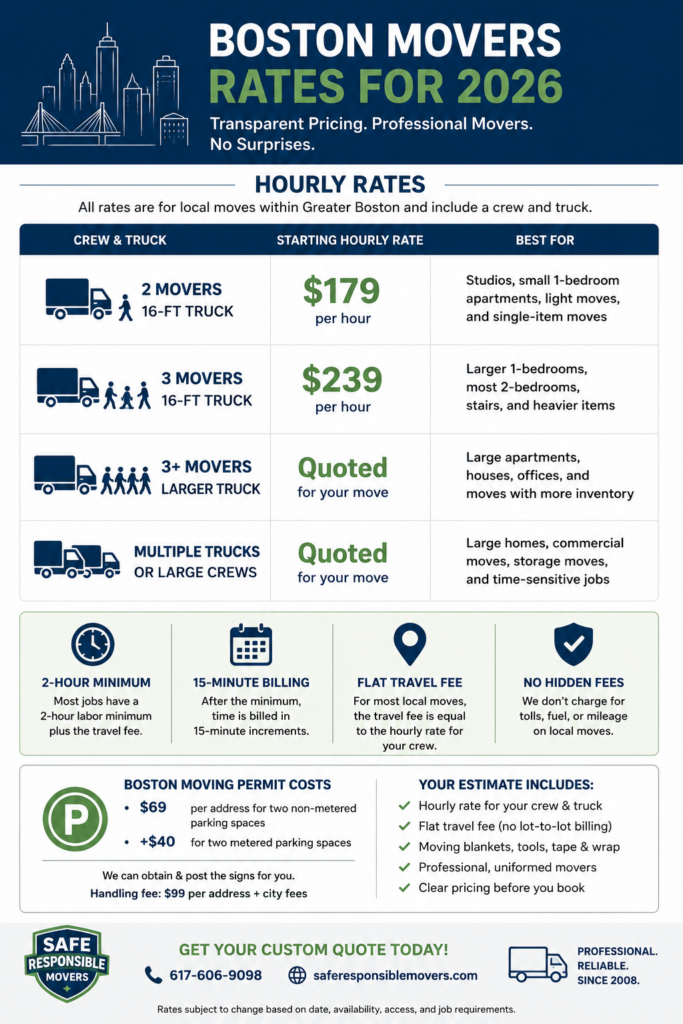
Our standard local rates include the movers, moving truck, furniture pads, dollies, straps and basic tools.
- Two movers and a 16-foot truck: $179 per hour plus travel fee
- Three movers and a 16-foot truck: $239 per hour plus travel fee
- Labor minimum: Two hours
- Billing: Time after the minimum is billed in 15-minute increments
Larger crews, 26-foot trucks, multiple trucks, packing materials and specialty services are quoted according to the job. Your written estimate will explain the hourly rate and travel charge before you book.
The building’s access rules can have as much effect on the total cost as the amount of furniture. A slow elevator, distant loading entrance, dock delay or long interior hallway adds labor time even when the apartment itself is small.
Moving Services Available in Seaport and Fort Point
Apartment and Condominium Moving
We handle studios, apartments, luxury condominiums, lofts and larger residential moves. Our crews wrap furniture with moving pads and perform common furniture disassembly and reassembly when required.
Packing Services
Our packing services are available for complete homes, individual rooms, kitchens, offices, artwork and fragile belongings. Packing can be scheduled before the move or incorporated into a larger project.
Labor-Only Moving
Our labor-only movers can load and unload rental trucks, PODS, U-Boxes, Pack Rat containers and ABF U-Pack equipment. We also handle same-building moves and furniture rearranging within an apartment, office or studio.
Peloton Moving
Our Peloton movers handle Peloton Bike, Bike+, Tread, Tread+ and Row equipment. Some machines require partial disassembly and additional movers depending on the elevator, stairs and route to the truck.
Single-Item Moving
Our single-item movers can move couches, tables, exercise equipment, artwork, office furniture and other individual pieces. Send photographs, measurements and building-access details so we can recommend the correct crew.
Frequently Asked Questions About Seaport and Fort Point Movers
Do Seaport buildings require a certificate of insurance?
Many professionally managed buildings require a COI, but requirements differ. Ask management for its current insurance instructions and send them to us before moving day.
How much do Seaport movers cost?
Our standard rate for two movers and a 16-foot truck is $179 per hour plus travel. Three movers and a 16-foot truck cost $239 per hour plus travel. There is a two-hour labor minimum, with additional time billed in 15-minute increments.
Do I need to reserve the freight elevator?
Most managed high-rises require an elevator reservation for a move. Some Fort Point buildings also restrict elevator use or require a scheduled appointment. Confirm the reservation directly with management.
Can your truck fit in my building’s loading dock?
That depends on the dock’s height, width, turning area and truck restrictions. Ask management for the maximum vehicle dimensions and send those requirements to us before we assign the truck.
Can you move oversized furniture from a Fort Point loft?
Yes, when the item can be moved safely. Large furniture may require disassembly before it will fit through the elevator or service entrance. Send photographs and measurements in advance.
Do you move artist studios?
Yes. We can move properly packed artwork, worktables, shelving, tools and studio equipment. Extremely valuable art, museum collections or pieces requiring specialized climate control may require a dedicated fine-art mover.
Do I need a Boston moving permit?
A permit may be useful when the truck must use public curb space rather than a private loading dock. A Boston moving permit reserves legal and accessible parking, but it does not override loading zones, bike lanes, hydrants or other parking restrictions.
Do you handle Seaport office moves?
Yes. We move offices, studios and small commercial spaces. Tell us about security procedures, insurance requirements, dock appointments and any restriction on moving during business hours.
Get a Quote From Our Seaport and Fort Point Movers
When requesting a quote, provide the complete building name and address, unit size, elevator reservation, loading-dock instructions, parking information and certificate-of-insurance requirements. Tell us about long hallways, oversized furniture, artwork, exercise equipment and any hard deadline imposed by the building.
The more accurate the access information, the better we can match your move with the correct truck and crew.
Request a quote from Safe Responsible Movers for your Seaport or Fort Point move.