
Hardest Neighborhoods for Boston Movers
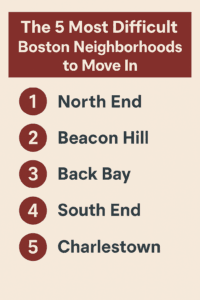
The 5 Most Difficult Boston Neighborhoods to Move In: A Local Mover’s Ranking
Moving anywhere in Boston can be a challenge, but some neighborhoods push even the most experienced crews to their limits. Tight streets, impossible parking, old buildings with narrow staircases, and long walks all combine to slow down a move and raise the difficulty level. After years of handling moves all over the city, here is the definitive ranking of the most challenging neighborhoods for a Boston moving company. If you are planning a local move, this guide explains exactly what to expect and why these areas require extra planning, strong crews, and proper moving permits.
1. The North End: The Hardest Neighborhood to Move In
The North End is easily the number one most difficult neighborhood for moving in Boston. It is beautiful and historic, but it was not built for modern moving trucks. The parking situation is rough even for residents, and for large trucks it becomes almost impossible.
Extremely limited truck access
Large 26′ trucks can safely travel on a small number of streets in the North End. The main workable routes include Hanover Street, Thacher Street, Commercial Street, Atlantic Avenue, and sections of North Street. Everything else is either too tight for a 26ft truck
Moving permits are mandatory
If you do not reserve a legal parking spot, you are not getting a truck anywhere close to your building. A Boston moving permit is essential. Even then, you need to monitor the permit signs closely, because locals sometimes take them down or block the reserved spot with their own car. If your mover arrives and there is no space for the truck, the entire move can grind to a halt.
Narrow staircases and walkups
The North End’s housing stock consists of older brick buildings with steep, tight staircases. Fifth and sixth floor walkups are common. Many modern pieces of furniture simply do not fit. Crews often need to remove doors, maneuver in tiny landings, or pivot heavy items with precision. It is a full workout for everyone involved.
Why it ranks number one
It combines the worst parking, the worst truck access, the narrowest staircases, and some of the highest walkups in the entire city. If any neighborhood deserves the top spot as the most difficult place to move in Boston, it is the North End.
2. Beacon Hill: Historic Charm and Tight Streets
Beacon Hill is number two on the difficulty scale. It has many of the same problems as the North End, but usually with slightly better truck access. Even so, it is a tough place to operate on moving day.
Selective truck routes
Some streets can handle a big truck. These include Pinckney Street, Revere Street, sections of West Cedar, Hancock Street, Bowdoin Street, and Mount Vernon Street by the State House. Other roads are simply too tight or contain sharp turns that a large vehicle cannot make. Planning the truck’s route in advance is crucial.
Long staircases and older buildings
Beacon Hill’s classic brownstones often have long, narrow staircases that can take more time than a standard two or three floor walkup. Crews need to be sized correctly for the job, because carrying furniture up several long flights adds a significant workload.
Permit-heavy neighborhood
Moving permits are strongly recommended in most areas. Without one, the chances of having legal or accessible parking drop dramatically. One of the hidden costs of moving in Boston can be extra time on the clock due to parking issues.
Why it is number two
The streets are a problem, the turns require planning, and the staircases demand extra muscle. Beacon Hill is not as chaotic as the North End, but it is still one of the most difficult neighborhoods in the city for moving.
3. Back Bay: Wide Streets but Long Walks
Back Bay ranks third. Compared to the North End and Beacon Hill, the streets are a relief because they are wider, straighter, and built later. The big issue in Back Bay is not tight streets but long staircases, heavy items, and long walks.
Better parking but still competitive
Back Bay parking is not easy, but it is much more manageable. With a moving permit, crews can usually secure a legal spot near your building. Large trucks can navigate most streets without trouble.
Long staircases
Because many Back Bay buildings were constructed with tall ceilings and older architectural style, the floors sit higher than in other neighborhoods. What would be the second floor elsewhere often feels like the third floor in Back Bay. The climbs take longer, and heavy lifting gets harder.
Elevator limitations
Some of the larger buildings have small elevators that do not fit full pieces of furniture. In those cases, movers still need to carry items up long flights.
Why it ranks number three
Back Bay does not punish you with impossible streets, but the physical work inside the buildings is tougher than average. Many moves feel like extended stair workouts, especially with heavier items.
4. The South End: Narrow Streets and Permit Requirements
The South End ranks fourth on the difficulty list. It is easier than the North End, Beacon Hill, and Back Bay, but still brings its own set of challenges.
Parking is competitive
Parking is tighter than Back Bay. In many sections of the South End, a moving permit is needed to guarantee a spot within a reasonable walking distance. Otherwise, the truck might be forced half a block away, which adds time and labor.
Large truck access is decent
Most major streets can accommodate a moving truck without major problems. The real issue is the number of small side streets and the parklets in the middle of some squares. These grassy or tree-lined center areas turn simple turns into tight squeezes.
Staircases vary widely
Some buildings have easy layouts. Others have long staircases that feel similar to Back Bay. The variety means no two moves are the same.
Why it ranks number four
The South End combines tough parking with tricky street layouts but is still more forgiving than the top three neighborhoods.
5. Charlestown: A Mix of All Challenges
Charlestown rounds out the list at number five. It contains a blend of everything that makes Boston moving difficult. While it is not as extreme as the North End or Beacon Hill, it still requires experience and planning.
Mixed street widths
Some streets are fine. Others are narrow enough that a large truck needs to be careful when making turns. There are several areas where navigating a big vehicle requires slow, deliberate maneuvering.
Permit necessity
Moving permits are almost always recommended. Without one, you risk long walks and wasted time.
Varied staircases
Charlestown’s housing stock includes tight North End style stairs and long Back Bay style stairs. It depends on the building. Crews need to be ready for either.
Why it ranks number five
Charlestown has a little bit of everything: narrow streets, tough parking, and unpredictable staircases. It does not hit the same extreme as the top neighborhoods, but it is still one of Boston’s tougher moving areas.
Final Thoughts
Boston is full of historic charm, but that charm comes with moving challenges. The North End and Beacon Hill remain the toughest places in the city, with Back Bay, the South End, and Charlestown close behind. Proper planning, the right crew size, and the correct moving permits can make the difference between a smooth move and a stressful day.
If you need help navigating these neighborhoods, an experienced Boston moving company that knows the streets, the rules, and the layouts can save time, effort, and frustration.