
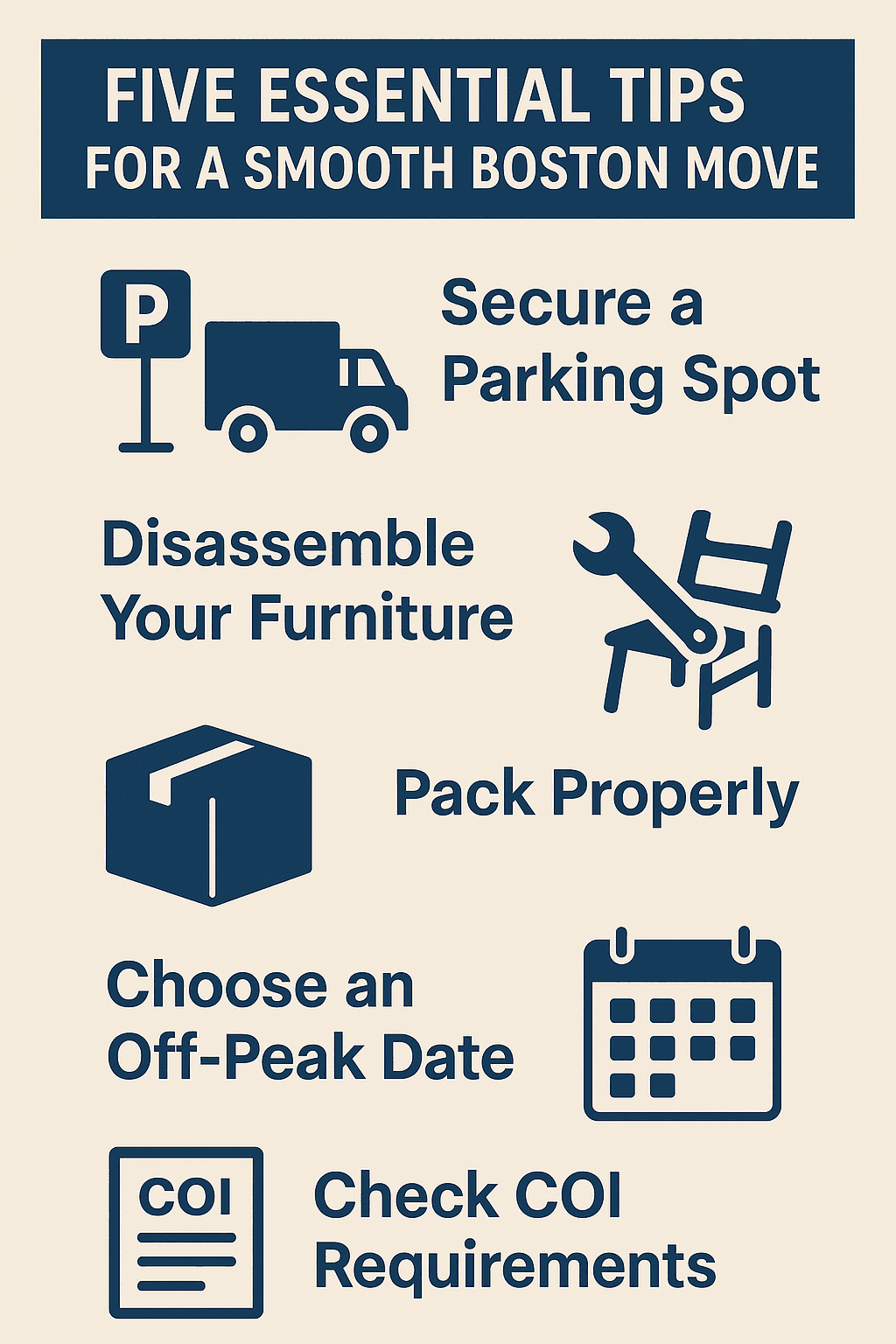
Tips for a Smooth Move in Boston
Moving anywhere in Boston comes with its own brand of chaos – tight streets, stubborn staircases, unpredictable parking rules, and buildings with more regulations than a downtown construction site. After handling thousands of moves across the city, here are the five tips that consistently save customers the most time, money, and stress.
1. Secure a Safe, Legal, and Accessible Parking Spot (Don’t Skip This)
If there’s one thing that derails Boston moves more than anything else, it’s parking. You can’t have a smooth move if your movers are circling the block or parked half a mile away. Boston’s streets are tight, competitive, and unforgiving — so lining up a proper space matters more than people realize.
Most neighborhoods require official moving permits to reserve curb space. You can get them yourself through the city, they’re available at boston.gov/moving, or in person at Boston City Hall. The city charges $69 per address, plus an additional $40 if there are meters on the block.
If you’d rather not deal with the process, we can acquire and post permits for you. We charge $99, which includes picking up the permit, posting the signs, and handling the logistics. Whether you get the permits yourself or have us handle it, just make sure you actually reserve the spot. It’s the single biggest factor in whether your move starts smoothly or spirals into a headache.
2. Disassemble and Reassemble Your Own Furniture
If you’re trying to trim your moving bill like most people, this is the easiest win. Breaking down your own beds, desks, and furniture can shave real time off your move, especially in Boston’s notorious walkups.
Movers can absolutely handle disassembly and reassembly, but it takes time. Time equals cost. If you have Allen keys, screwdrivers, or a cordless drill and a free evening, you can do yourself a big favor by getting ahead of this step before moving day arrives.
Keep all hardware in labeled bags taped to the furniture pieces or stored together in one box. It’ll make reassembly infinitely easier.
3. Pack Boxes Properly
Good packing makes or breaks efficiency. If you want your movers to work quickly and safely, being fully packed is non-negotiable.
A few golden rules:
Every box must be fully taped on both the top and bottom. No half-closed flaps. Your boston movers will thank you.
Don’t overload large boxes. Wardrobe boxes, “extra large” boxes, and oversized cartons shouldn’t be filled with books, weights, records, or anything dense. These boxes are designed for blankets, pillows, linens, coats, and lightweight bulk.
Heavy items go in small boxes. Keep them manageable so nothing bursts open or slows the crew down.
Fragile items need padding. Newspapers, bubble wrap, towels — anything is better than nothing.
Being completely packed and organized before your movers arrive will speed up the job and reduce the risk of damage.
4. Choose an Off-Peak Moving Date if Possible
Boston’s moving calendar has predictable spikes. A few dates are always more expensive:
Weekends
The first few days of the month
End-of-month crunch
September 1 (the chaos holiday known as Allston Christmas)
If you can aim for a weekday in the middle of the month, you’ll often get a better rate and more schedule flexibility. Movers aren’t racing from job to job, and you’re not competing for every available truck in the city.
Flexibility pays off , literally.
5. Check Whether Your Building Requires a Certificate of Insurance (COI)
This one blindsides a lot of people. Larger apartment buildings, especially in downtown Boston, Back Bay, Fenway, Seaport, and Cambridge often require movers to provide a Certificate of Insurance (COI) before you can move in or out.
COIs protect the building in case of accidental damage to elevators, hallways, or entryways. We can absolutely provide a COI, but we need some notice. These documents are created by our insurance agent, not instantly generated by us, so the earlier you check with your building, the better.
Common info your building may request:
Additional insured wording
Specific coverage limits
Dates and addresses for the move
Use of service elevators or loading docks
Get ahead of it so moving day doesn’t get delayed over paperwork.